|

|
|
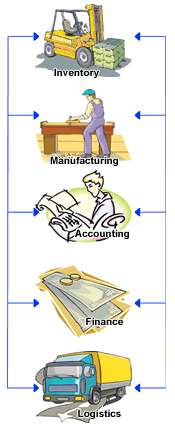
ERP is a system consisting of hardware and software components which integrates all departments of an enterprise. It increases the efficiency by providing the data communication between these departments.
ERP software is made up of 7 main parts:
- Accounting / Finance
- Manufacturing Management
- Purchasing Management
- Sales Management
- Inventory Management
- Quality Management
- Human Resources
|
|
 |
How does ERP increase the efficiency of a company?
- It provides the integration within the company. This way, every department can easily get to the information they need.
- It provides real-time control over the inventory.
- Manufacturing stages and every order being manufactured can be monitored.
- With the information gathered, future manufacturing plans can be made.
- The need for raw material for each order can be checked with the inventory and a list of the raw materials can be prepared.
- Manufacturing costs are calculated using the product tree and product recipes.
- Managers get to the decision making supportive reports and certain results quickly.
- With the convenience of the system, the company saves time, labor and respectively money.
|
The term ‘MRP’ was first used in 60’s by Orickly at IBM, relating to the keeping the inventory records and tracking, together with the dependent demand concept. It became the supportive sub-system of manufacturing management in the following years. It took its place within manufacturing management as a developed information system and a planning & control technique using comparisons (DAGLI, 1984).
MRP (Manufacturing Resource Planning) philosophy was born in 60’s when manufacturing was growing fast. With the huge demand occurred because of the growing economy, the manufacturers were pushed to fast and high-volume manufacturing. The main problem was to predict the needed supply amount that will be enough for the targeted manufacturing amounts.
To overcome this problem, the manufacturers started to use computers and defined their product trees, sales predict and other statistical information related to the parts to these computers. By matching the data entered, the computers started to be able to decide the amount of raw materials needed. Later on, the problem was solved when computers began to calculate the required purchasing amount by looking at the amount of goods in inventory and comparing them with the amount of materials needed.
In brief, Manufacturing Resource Planning is a group of processing techniques aiming to decide the raw-materials and parts used in the main manufacturing program for the after-product. Having an easy and clear logic, MRP is a planning approach which requires the amount of all the components needed (raw-materials, parts, sub-assemblies) over all the products which are within the subject of the manufacturing plans of the company.
Even if the logic is quite simple, the data and processing volume makes MRP, an important approach. Beside the amount of information processing needed to calculate the each part of each product (some may contain hundreds of parts), the changes within the main manufacturing plan need to be done quick and frequently.
In the beginning, these systems were used with the help of giant computers which may fill a room by themselves. And therefore only a few big companies could afford to buy them. By time, as the computer technology and industry evolved; high-performance, less-expensive, fast-processing computers started to be used widely. With the software applications developing correspondingly, the use of computers became wide-spread.
You can see the list of inputs and outputs of an MRP system in Figure 2.
MAIN PRODUCTION PROGRAM
- What will be manufactured?
- When will it be manufactured?
PRODUCT TREE INFORMATION INVENTORY INFORMATION
- Product structure
- Product trees
- Time period to acquire
- Inventory quantities
- Levels of critical inventory quantities
MANUFACTURING RESOURCE PLANNING
- Using the main rule, it determines the net supply need
- Purchasing Orders, Manufacturing Orders, Re-Charting Orders
|
Figure 2. MRP Inputs and outputs
MRP system cannot function without these tree inputs. For this reason, companies willing to use the MRP system have to prepare these three inputs beforehand.
In figure 2, you can see a product tree for the product ‘M’. Let’s prepare the required materials plan using this.
Figure 3. Product tree for product ‘M’.
|
Part |
Description |
Time Period to Acquire |
Time (Weeks) |
|
1 |
2 |
3 |
4 |
5 |
6 |
| M |
Gross
Need
In Stock
Net
Planned
Manufactured
Order
|
1 |
|
|
|
|
80 |
100
20
80
80
|
| A |
Gross
Need
In Stock
Net
Planned
Manufactured
Order
|
2 |
|
|
|
130 |
160
30
130
130
|
|
| B |
Gross
Need
In Stock
Net
Planned
Manufactured
Order
|
1 |
|
|
|
200 |
240
40
200
200
|
|
| C |
Gross
Need
In Stock
Net
Planned
Manufactured
Order
|
1 |
|
240 |
260
20
240
240
|
|
|
|
| D |
Gross
Need
In Stock
Net
Planned
Manufactured
Order
|
2 |
370 |
200 |
390
20
370
370
|
200
0
200
200
|
|
|
| E |
Gross
Need
In Stock
Net
Planned
Manufactured
Order
|
3 |
390 |
|
|
400
10
390
390
|
|
|
Table 1. Manufacturing Resource Planning for product ‘M’
As can be seen from the figure, product ‘M’ represents the independent; others represent the dependent goods in stock. To say it the other way; the requests of A, B, C, D and E depends on the request of M. On the other hand, the required time period and current level of stocks for M, A, B, C, D, E are 1, 2, 1, 1, 2, 3 weeks and 20, 30, 40, 20, 20, 10 respectively. According to the manufacturing program: if we are to produce a hundred ‘M’s, the resource planning need to be as on Table 1.
In various published materials, companies beginning to use MRP system are said to benefit from; lower stock levels, less inventory keeping costs, less time periods to acquire, better timing of order delivery. But even if MRP system is providing these, it still has some defects. For example; while providing the resource requirements, manufacturing and purchasing orders, it does not observe if the factory capacity is available for them. This caused the Closed-Loop Manufacturing Resource Planning to develop. Closed-Loop Manufacturing Resource Planning is used within the frame of MRP, including other functions of manufacturing planning, main manufacturing program and capacity requirements planning. The important point here is, providing control over the workshop level. In other words, importance is containing capacity requirements planning within the overall plan.